

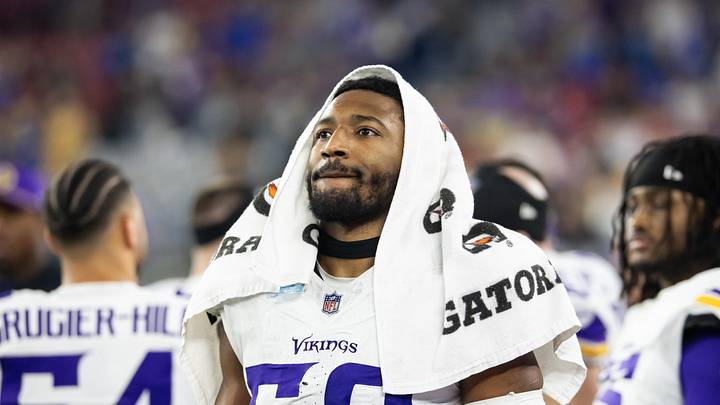
The Minnesota Vikings didn’t make a lot of big moves this offseason, and fans may still be waiting for the biggest as the Vikings wrap up their process to find a new general manager. But one of the biggest moves was the trade that sent Jonathan Greenard to the Philadelphia Eagles.
Vikings fans were not happy after their favorite team traded their best pass rusher to a conference rival, and they were even more upset when the deal only netted them a pair of third-round picks in return.
ESPN’s Bill Barnwell echoed those feelings as he called the trade the worst move the Vikings made this offseason, but it seemed to miss the point since the Eagles also had to give Greenard a massive contract extension as part of the trade.
“I can understand why the VIkings traded Greenard,” Barnwell wrote. “...However defensive tackles like Quinnen Williams and Dexter Lawrence landed first-round picks in deals, and edge rusher Maxx Crosby (briefly) netted the Raiders two first-rounders. Did the Vikings really do themselves any favors by waiting until late April to deal Greenard? They landed only a pair of third-round picks from the Eagles. One of those picks was the 98th selection in this year’s draft, and it would be a surprise if the 2027 third-rounder landed anywhere before No. 90.
“Two late third-round picks isn’t a ton for a player as explosive as Greenard, who was still blowing by people on tape at less than 100 percent a year ago.”
Jonathan Greenard’s contract situation watered down Vikings’ return in trade with Eagles
Looking at Greenard’s stats, it’s hard to disagree with Barnwell. The 29-year-old racked up 12.5 sacks in his final year with the Houston Texans in 2023 and continued to be a wrecking ball for opposing offenses with 12 sacks in his first year with the Vikings in 2024. While he had just three sacks last season and played through a shoulder injury, he was still effective, leading Minnesota with 47 pressures and a 16.6 percent pass rush win rate according to Pro Football Focus.
But the Vikings didn’t trade Greenard because he wasn’t productive. Rob Brzezinski told reporters hours after the trade that the trade “is not making [us] a better team today,” but also noted that Greenard’s request for a “market value correction” reported by SI’s Albert Breer made him too expensive to keep.
“The value ends up being what the market will pay,” Brzezinski said via Alec Lewis of The Athletic. “Obviously, JG is a great player. I’m sure people have a lot of opinions about what the appropriate value should be for him. All I can say is that, considering everything, we thought it was in the best interests of all parties. People can judge whether or not it was fair for a player of that caliber, and we understand that. But it’s what the market would pay.”
The argument continues if you believe some other team would have upped the amount of draft capital going back to Minnesota in a trade. But it screeches to a halt considering the four-year, $98 million contract extension the Eagles gave Greenard upon completion of the deal, per Spotrac.
Barnwell acknowledged the financials of the deal are “team-friendly” which carries low cap hits of $15.7 million in 2028 and $20.2 million in 2029. But it also spreads $44.4 million over four void years, giving Philadelphia a huge hold on their books as Greenard goes into his mid-to-late 30s.
In addition to the contract, it was a component that was not a factor in the trade for Crosby or Williams. Crosby was coming to the Ravens in the final two years of a three-year, $106.5 million contract before he failed a physical, and Williams, entering the final year of a four-year, $96 million contract signed in 2023, neither team had to pay upon arrival, limiting what teams were willing to give up for Greenard.
With a ready-made replacement in Dallas Turner available and those savings used to sign Jauan Jennings, it made more sense to trade Greenard and let someone else pay him. But it hasn’t stopped analysts like Barnwell from acting like the Vikings traded the second coming of Chris Doleman or Jared Allen.
The real result of the trade won’t be known until both teams hit the field this fall, and it remains to be seen whether the Vikings or the Eagles got the upper hand in the deal.
 Add us as a preferred source on Google