

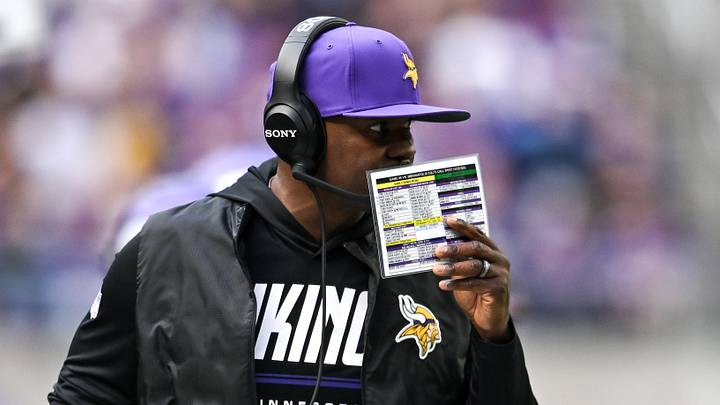
The Minnesota Vikings blitzed Indianapolis on 85.2 percent of its dropbacks Sunday, an outrageous level of aggression even for a Brian Flores defense. Minnesota didn't merely survive the approach. It strangled the Colts' passing game in a 16-10 win.
NBC Sports research found that Minnesota's 85.2 percent blitz rate was the highest single-game mark recorded since the Next Gen Stats era began in 2016. Indianapolis finished with 64 net passing yards, Daniel Jones was sacked four times, and his final possession ended with an interception.
Flores can live at that extreme because his defense isn't simply sending extra rushers and hoping somebody wins. Minnesota spends the pre-snap period threatening pressure from multiple gaps, then changing which defenders actually attack and which retreat into coverage.
Minnesota Vikings disguise makes Brian Flores' blitz rate harder to punish
Blake Cashman is central to making the operation function. Minnesota's green-dot linebacker has to organize a defense that can present six or seven potential rushers while still getting everyone into the proper coverage once Flores changes the picture. His ability to cover also lets the Vikings threaten an A-gap blitz without automatically surrendering the middle of the field.
Simulated pressure adds another layer. Minnesota can crowd the line with linebackers, safeties, and edge defenders, rush only four or five, and drop a player the quarterback expected to attack. The protection can still react as though a heavier pressure is coming, creating favorable matchups without exposing the secondary to the risks normally attached to an all-out blitz.
Harrison Smith remains particularly valuable because his disguise ability gives Flores another movable piece. Smith can align near the box, threaten an interior gap, rotate deep after the snap, or replace a linebacker in coverage. A quarterback trying to identify the fourth, fifth, or sixth rusher has to account for a veteran safety who has spent years baiting protection calls.
The legitimate concern showed up against Indianapolis anyway. The Colts ran for 154 yards, another reminder that committing bodies near the line doesn't automatically produce clean run fits. Minnesota has already seen how explosive rushing plays can come at the cost of an aggressive structure.
Detroit is the matchup that should test how far Flores wants to push this. Jared Goff has the experience, protection control, and play-action game to punish defenders who declare too soon, while Jahmyr Gibbs, Amon-Ra St. Brown, and Sam LaPorta give the Lions answers at every level. Flores probably won't abandon pressure.
The question for Flores will be whether 85 percent becomes a one-week spike or another line Flores is perfectly willing to cross against an NFC North offense built to attack it.
 Add us as a preferred source on Google