

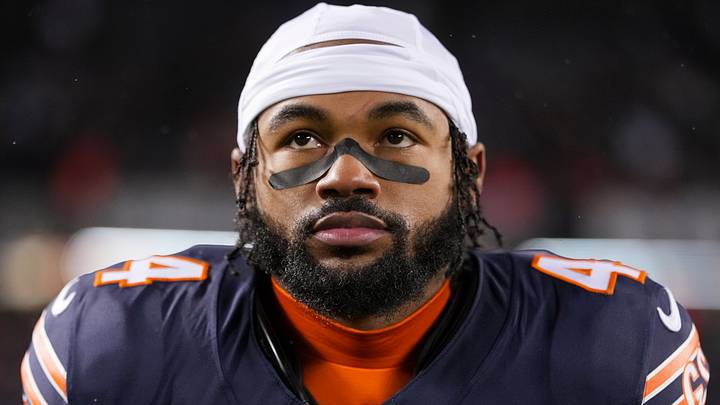
The Minnesota Vikings have high expectations for this season, and a lot of it has to do with the running game. A brand-new scheme is something that should get more out of Kevin O’Connell’s offense this season, but it also could have a cost, as Aaron Jones and Jordan Mason are both entering the final year of their contracts.
Both backs’ contract status could be an interesting talking point if the Vikings’ ground game takes off this season. But it could also lead to a pricey decision after the Chicago Bears agreed to a three-year, $33.75 million contract extension with $27.5 million guaranteed on Friday afternoon, according to ESPN’s Adam Schefter.
With another NFC North back getting paid, it could give the Vikings the avenue to do the same if Mason or Jones has a big season. But new general manager Nolan Teasley’s past with the Seattle Seahawks and Minnesota’s strategy since O’Connell arrived in Minnesota suggest the Vikings may look to spend their money elsewhere.
Nolan Teasley’s history could spell trouble for the Minnesota Vikings running backs
It wasn’t long ago that the Vikings weren’t afraid to throw big money at the running back position. Adrian Peterson signed a six-year, $85.2 million contract in 2011 and a three-year, $42 million contract extension in 2015 before Minnesota selected Dalvin Cook in the second round of the 2017 draft.
After Cook ran through his rookie deal, he signed a five-year, $63 million extension that was cut short when he was released after the 2022 season.
With the exception of Cook’s contract, which was grandfathered into the first year of the regime led by O’Connell and former general manager Kwesi Adofo-Mensah, the Vikings turned to Alexander Mattison as a cheaper alternative.
That decision didn’t age well, as Mattison failed to score a rushing touchdown on 180 carries in 2023, and seventh-round pick DeWayne McBride failed the team out of training camp. But even with those failures, the Vikings still picked up a short-term option when they signed Jones to a one-year, $7 million contract in the spring of 2024.
There have been a couple of notable contracts since, as Mason signed a two-year, $10.5 million contract extension after he was acquired in a trade with the San Francisco 49ers before the 2025 season, and Jones signed a two-year, $20 million extension that was renegotiated to a one-year, $5 million contract for this year.
Either back could find their way back to the negotiating table at the end of the year if the scheme led by offensive line coach Keith Carter and assistant head coach Frank Smith works like it’s supposed to. But before Vikings fans can think of Jones or Mason signing an extension, the history of Nolan Teasley’s time with the Seattle Seahawks suggests otherwise.
After Marshawn Lynch’s retirement after the 2015 season, the Seahawks used Chris Carson’s rookie contract to fill the void, but even when it came time to extend him, Seattle only gave him a two-year, $10.4 million contract before he suffered a chronic neck injury that ended his career during the 2021 season.
Kenneth Walker and Zach Charbonnet were drafted in back-to-back seasons in the wake of that injury, and the duo helped lead Seattle to a Super Bowl victory. But when Walker’s contract expired, the Seahawks allowed him to leave for the Kansas City Chiefs before selecting Jadarian Price in the first round of April’s draft.
Minnesota Vikings could have cheap answers to their running back problems
Looking at what the Vikings have done under O’Connell and what Teasley did while working under John Schneider in Seattle, it can be assumed both would rather go with a cost-effective option at running back as opposed to paying top dollar.
While teams like the Bears have been more receptive to paying running backs, offering up over $10 million to Mason if he has a big year or another short-term band-aid to Jones may not be what they have in mind – even with O’Connell’s admiration for Jones.
Another factor is sixth-round rookie Demond Claiborne. While Claiborne is still a project who’s working on pass protection and adjusting to the level of competition in the NFL, he also has potential that led Jones to compare him to Detroit Lions star Jahmyr Gibbs during training camp.
If Claiborne improves as the year progresses, it’s not hard to see him seizing a bigger role. And if the Vikings decide that Mason will be too much to keep around, they could dive into next year’s draft class, which could have affordable options, including Florida’s Jaden Baugh, Ole Miss’s Kewan Lacy, and Missouri’s Ahmad Hardy.
This could be even more likely if the Vikings’ ground game overhaul succeeds. If the scheme gets the most out of the current trio of running backs, the Vikings could feel like it could do the same to whoever they add, no matter what they cost.
It’s a tendency that has played out over the past few years and one that could have the Vikings taking an alternate approach after the Bears extended Swift.
 Add us as a preferred source on Google