

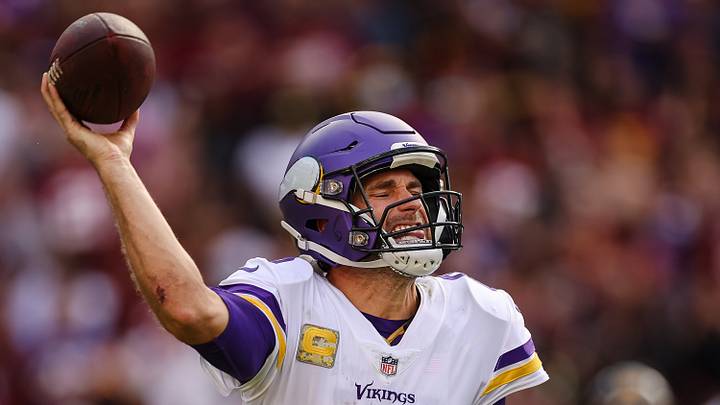
The Minnesota Vikings have won their first five games of the season and will look to improve to 6-0 for the first time since 2019, when they battle the Indianapolis Colts in Week 7. While there are plenty of reasons to be excited about this year’s team, questions remain about the future of the Vikings, namely, who will play quarterback.
With no quarterback on the roster signed past this season, the room is ripe for speculation. It’s led many to speculate about a potential trade for Los Angeles Chargers star Justin Herbert. But unless a rough 2026 season makes him available, The Ringer’s Tom Pelissero reasoned the Vikings may not want to pay a steep price to bring him in because of their history at the position.
Pelissero said on "The Bill Simmons Podcast" that the Vikings eventually want to “solidify the quarterback position,” which is why they drafted J.J. McCarthy. But the Vikings have also found success with inexpensive quarterbacks like Kyler Murray and Sam Darnold, giving them flexibility to strengthen the supporting cast and lean on Brian Flores' defense.
The NFL insider noted that this approach goes against the league's typical formula of drafting a quarterback, winning on his rookie contract, and eventually having to pay him $60 million annually, leaving less money for the rest of the roster.
While Kevin O’Connell may want to get off the quarterback carousel, Pelissero said, “But it’s not a bad formula for the way that they are structured, because it gives them those other opportunities.”
Minnesota Vikings trade for Justin Herbert could cut out the middleman in their QB search
Connecting the Vikings to Herbert (if he’s made available) doesn’t take much calculus. Kyler Murray has led the Vikings to a 5-0 start, but he hasn’t looked comfortable until the final quarter of a Week 4 win over the Miami Dolphins and a Week 5 win over the New Orleans Saints. Carson Wentz and Max Brosmer also aren't likely long-term options for the Vikings, so they may look for another new quarterback this offseason.
The 2027 quarterback class was supposed to have several options, but top names such as Oregon’s Dante Moore or Notre Dame’s C.J. Carr may not be available if the Vikings remain competitive in the second half of the season, and others such as Texas’s Arch Manning and Oklahoma State’s Drew Mestemaker could wind up staying in school and thinning out this year’s class.
After running out of patience with McCarthy, the Vikings also may not be in a hurry to draft another quarterback. That could lead them to cut out the middleman and take Herbert if he is made available.
Herbert has had a rotten season with the Chargers, with a career-low 59.4% completion rate to go with 937 yards, five touchdowns, and an NFL-high seven interceptions heading into Sunday. Those numbers didn’t get better in a loss to the Kansas City Chiefs, where he completed 22-of-37 passes for 204 yards and threw an interception. But he also has a strong track record, completing 66.2 percent of his passes for 25,757 yards, 168 touchdowns, and 65 interceptions over his seven-year career.
Given the Vikings' history of quarterback issues, acquiring Herbert, who won’t turn 29 until next March, would be a long-term solution, as his contract doesn’t expire until after the 2029 season. The Vikings could make that even longer by offering an extension that would lower his current scheduled cap hit of $58.3 million, according to Over The Cap, but their history suggests they may be fine with the way they’re currently handling the situation.
Vikings history suggests they could be just fine passing on Herbert
Pelissero cited Vikings history as a reason not to trade for Herbert, and that makes sense given what the team has done recently. When the Vikings paid Kirk Cousins big money to solidify the quarterback position, it put immense pressure on Minnesota to fill out the roster with draft picks and cheap free agents, which led to one playoff win and just two playoff appearances in his six seasons in Minnesota.
When Cousins left, the Vikings pivoted to Darnold on a one-year, $10 million contract for the 2024 season. With Justin Jefferson, Jordan Addison, and T.J. Hockenson as skill players and O’Connell on the sidelines, Darnold led the Vikings to 14 wins before leaving in free agency the following offseason.
The Vikings then tried the long-term approach with McCarthy. But his rawness as a prospect and the Vikings’ urgency to win were a bad combination, and it led to a trade to the New York Giants. That whiff seemingly only cost Minnesota one season; however, Murray and Wentz guided the Vikings to a 5-0 start this season.
If the Vikings keep winning but Murray doesn’t look like a good fit, he could head to free agency next spring. But while trading for Herbert would be the splashy move, it would cost the Vikings draft capital and the cap space needed to fit Herbert’s contract, which could force them to let go of some of the players who have helped Minnesota get the most out of their quarterbacks.
Perhaps O’Connell would rather not talk about drying concrete and fundamentals every year, or just wants a quarterback he can rely on. Maybe Nolan Teasley, who famously restocked the Seattle Seahawks cabinet by trading Russell Wilson as an assistant general manager under John Schneider, may also buck the trend, knowing the Vikings are close to a championship.
But the Vikings’ elite defense isn’t going away anytime soon and they still have the supporting cast to elevate most quarterbacks that could be available next offseason. That move wouldn’t be as sexy as trading for Herbert, but it would allow them to address their weaknesses by holding onto their draft picks and cap space and perhaps be a better recipe for sustained success.
 Add us as a preferred source on Google