

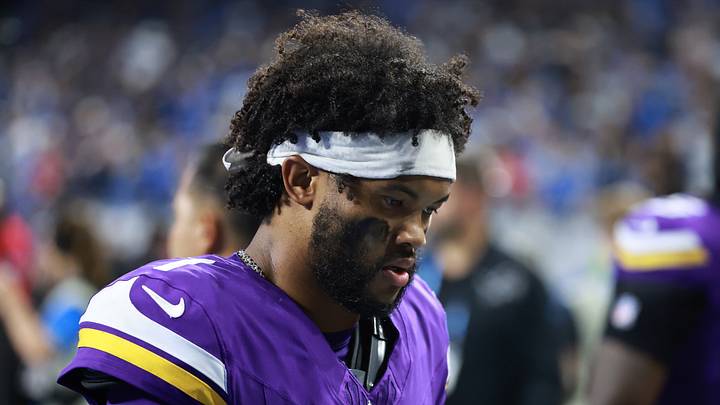
Kyler Murray isn't playing poorly enough for the Minnesota Vikings to panic at quarterback, but he is playing poorly enough that a team with Super Bowl expectations can demand substantially more.
Minnesota’s 19-15 loss to Detroit exposed exactly where Murray currently falls short. He finished 17-of-29 for 210 yards, one touchdown, and an interception, added 35 rushing yards, and helped produce a fourth-quarter lead. While those numbers don't warrant a benching, the Vikings managed only 15 first downs, converted three of 10 third downs, and generated 266 total yards.
Justin Jefferson catching five of nine targets for 33 yards matters more than the raw target count. Minnesota can technically feed Jefferson while still failing to exploit what makes him special. Murray missed opportunities to connect with him downfield, including throws where placement erased potential explosive gains, and Jefferson's frustration after Detroit only intensified a conversation already underway.
Minnesota Vikings need Kyler Murray to solve the plays already available
Murray’s biggest problem isn’t that Kevin O’Connell has asked him to become a different quarterback. It’s that too many routine pieces of O’Connell’s passing game are arriving late or inaccurately.
TruMedia data cited in CBS Sports' Murray analysis charted five of Murray’s 29 passes against Detroit as off target. His season numbers are more concerning. Murray entered Monday at minus-0.11 EPA per dropback with a 39.1 percent passing success rate, both career lows, while his 13 percent off-target rate was also worse than any previous season.
The timing issue compounds everything. Murray's PFF season profile lists him with a 3.20-second average time to throw and a 20.7 percent pressure-to-sack rate. Holding the ball that long can create scrambling opportunities, and Murray still provides value there, but it also turns workable protection into unnecessary pressure. Minnesota can't build its offense around winning second reactions on every third down.
Murray’s legs remain the strongest argument against reducing him to the offense’s lone problem. He led Minnesota in rushing against Detroit, and the Vikings’ running backs combined for only 46 yards. O’Connell also has an offensive line that has produced uneven results and a rushing attack that rarely forces defenses to change how they defend Jefferson.
That context explains why benching Murray for Carson Wentz feels premature, but it doesn’t excuse the quarterback. Minnesota already knows Murray can function efficiently within this offense. His 24-of-30 performance against New Orleans included 229 passing yards and 51 rushing yards, showing the kind of rhythm Minnesota needs more consistently.
The standard now has to rise because Minnesota is 6-1, the defense is giving O’Connell deep playoff possibilities, and Jefferson is in the middle of his prime. Murray doesn’t need to rescue a bad football team, but he needs to stop leaving attainable offense on the field for a very good one.
Detroit moved Murray from evaluation into proof. The Vikings can live with an occasional scramble, sack, or missed deep ball. They can't spend another month watching open receivers become incompletions while their championship-caliber defense keeps the margin for error microscopic.
 Add us as a preferred source on Google