

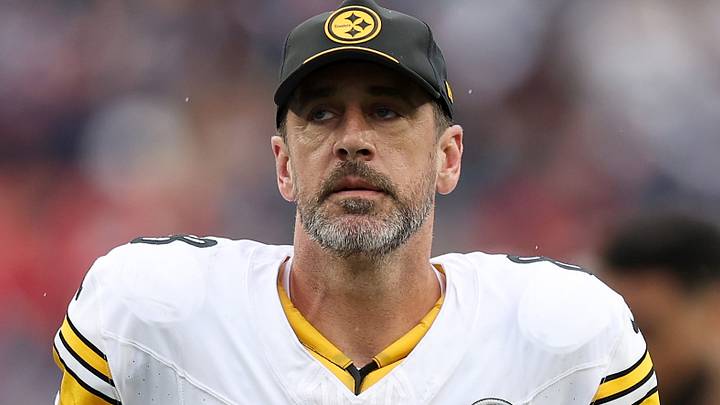
The Minnesota Vikings clearly chose the wrong quarterback last season when they made J.J. McCarthy their starter.
When the Vikings traded McCarthy to the New York Giants this past Monday, it had some fans validated in their belief that they should have brought in Aaron Rodgers, and The Athletic’s Alec Lewis recently ripped open that wound by reporting that many inside the Vikings building were on board with bringing in the former Green Bay Packers passer when he became available in the spring of 2025.
“The team mulled the idea for days after Rodgers pledged to play for a minuscule amount of money, and many endorsed the move.
But concerns with Rodgers’ potential fit and the possibility of McCarthy’s camp requesting a trade contributed to the Vikings’ dice roll that McCarthy could be a franchise quarterback for the long term.
The Vikings moved forward into the spring and summer hoping that an intentional structure could accelerate McCarthy’s growth. They thought their system and personnel would establish a distinct floor. It would not.”
With that, Rodgers sounds like the one who got away. But outside of an extra win or two, Rodgers arriving in Minnesota would have been a complete disaster and one that may have been just as disappointing as what happened with McCarthy.
Vikings avoided a nostalgia trap by not signing Aaron Rodgers
Like many things in Vikings history, the idea of bringing Rodgers to Minnesota was fueled by nostalgia. Back in the 1990s and 2000s, Brett Favre tortured the Vikings as the leader of the Packers until they pivoted to Rodgers and traded him to the New York Jets in 2008.
Favre spent a year with the Jets that was marred by a torn biceps, and it appeared he had retired for good the following spring.
At the same time, the Vikings had everything they needed to win except for a quarterback.
A core that included Adrian Peterson, Jared Allen, Kevin and Pat Williams, and Antoine Winfield provided a steady foundation, but Tarvaris Jackson wasn’t making enough progress to move forward, and the Vikings courted Favre until he decided to sign after training camp.
That 2009 season lives in Vikings lore as Favre threw for 4,202 yards, 33 touchdowns, and seven interceptions, and helped Minnesota go 12-4 and led them to the NFC Championship Game.
While fans would rather not talk about what happened in that game, it was a solid decision and one that seemed to mimic a path for Rodgers to come to Minnesota.
Like the 2008 version, the 2025 Vikings felt like they just needed a quarterback to take them where they wanted to go.
Sam Darnold was that quarterback after leading the Vikings to 14 wins, but his final two games in Minnesota led to the decision to let him leave for the Seattle Seahawks. Daniel Jones was a backup plan, but Lewis noted that the Vikings overestimated his willingness to return, leading to his departure to the Indianapolis Colts.
While McCarthy was considered the future, he was considered by many to be too raw and inconsistent to be a viable option, and Rodgers slithered his way into the picture once he was released by the Jets.
The parallels brought an interesting decision for the Vikings, who likely weren’t dreaming about 2009 as they were mulling things over. But to believe that Rodgers would have been the missing piece to a Super Bowl team is a nostalgic fantasy, knowing how things turned out.
Aaron Rodgers wouldn’t have solved any of the Vikings’ problems
After waiting the Vikings out through the summer, Rodgers signed a one-year deal with the Pittsburgh Steelers during minicamp.
Rodgers was effective enough to provide the baseline of quarterback play that O’Connell would be looking for in Minnesota, completing 65.7 percent of his passes for 3,322 yards, 24 touchdowns, and seven interceptions, and he would have been playing with a much better supporting cast.
But that also ignores the several underlying flaws with last year’s team. Christian Darrisaw was never healthy at left tackle, and Jordan Addison was out for the first three games due to a suspension for violating the NFL’s substance abuse policy.
Harrison Smith was out of sorts due to an illness in the first half of the season, and the free agents the Vikings had brought in, including Jonathan Allen, Javon Hargrave, and Ryan Kelly, were largely busts.
Rodgers would have given the Vikings a greater chance to overcome those obstacles, but it may have resulted in the same results he had in Pittsburgh, leading the Steelers to a 10-7 season and a loss in the Wild Card round to the Houston Texans.
In addition, the dynamic between Rodgers and O’Connell would have been interesting to see play out. Rodgers is determined to prove that he’s right no matter how wrong he is and admitted he has to do a “better job” of telling Mike McCarthy and his staff what’s not working after a Week 2 loss to the New England Patriots.
On Thursday night, Rodgers and McCarthy continued to butt heads, with Rodgers screaming profanities at his coach when he couldn’t hear the play calls, leading him to call him “an f****** a******” on the sidelines.
Purple Insider’s Matthew Coller also added that Rodgers looked “like playing football is the most dreadful thing on earth and he can’t believe he’s burdened with doing it,” and it’s the type of vibe that would have only added to a team that didn’t wake up until they were virtually eliminated from playoff contention with a 4-8 record.
Maybe the friendship between O’Connell and Rodgers may have prevented some of this from happening. But O’Connell showed he’s just as stubborn as Rodgers is last season, refusing to lean into a run-heavy offense that could have supported McCarthy until it was too late.
If anything, it may have resulted in another Wild Card loss, with coach and quarterback screaming at each other on the sidelines while McCarthy heaved errant passes in practice before the Vikings targeted their next aging rental at quarterback.
There’s also a chance this fantasy could still play out this season. If the Steelers fall apart and Kyler Murray doesn’t show improvement, the Vikings could hit the market for a quarterback and make a call to Pittsburgh.
But that wouldn’t solve anything either, as Rodgers’s pocket presence has disappeared at 42 years old, and he would play behind an offensive line that has a makeshift center in Blake Brandel and an overpaid guard in Will Fries.
There were several ways the Vikings could have improved at quarterback last season and could improve this year. But thinking Rodgers would have been the answer is revisionist history that wouldn’t have changed much last year or in the future.
 Add us as a preferred source on Google