

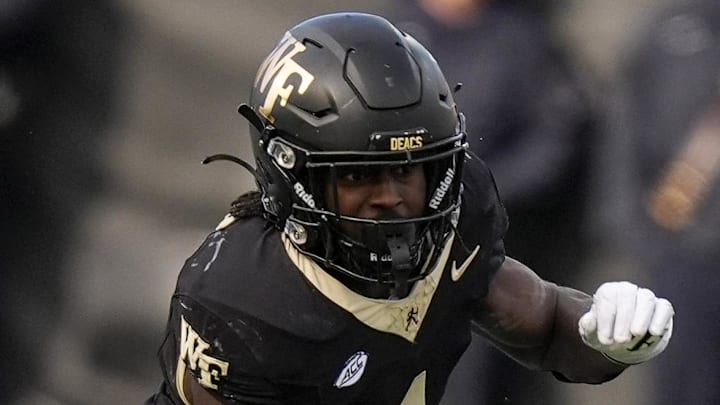
With the surprising return of Aaron Jones and Jordan Mason still around, 2026 is a contract year for both of the Minnesota Vikings' top two running backs. So it was practically guaranteed they were going to draft a running back, and after a trade up in the sixth round, they paid off their pre-draft interest in Demond Claiborne out of Wake Forest.
Claiborne (5-foot-9, 188 pounds) is on the small side, but he has speed to burn (4.37-second 40-yard dash time at the NFL Combine), and he will add juice to a Vikings' ground game that needs it badly.
He has ability as a pass catcher that can be further developed in the NFL, with prowess as a kickoff returner and a nose for the end zone (21 rushing touchdowns over his last two seasons at Wake Forest).
With Jones being over 30 years old and Mason being an active detriment to the situation on passing downs due to his struggles as a pass blocker, it might not be as tough for Claiborne to notably contribute right away as it seems.
Of course, due to his size, Claiborne's ability to pass protect at the next level is easy to question. While Pro Football Focus was generally not high on his work there over his four years at Wake Forest, he did earn a 66.2 pass blocking grade as a junior in 2024 on 159 pass blocking snaps.
Demond Claiborne's best path to rookie season relevancy for the Minnesota Vikings is clear
PFF fantasy analyst Nathan Jahnke has Claiborne on his list of sleeper rookie running backs to target in dynasty drafts.
"Claiborne is a small, speedy running back with great change-of-direction ability. Our draft guide compared him to Justice Hill and mentioned his upside as a receiving running back.
He is not expected to become a three-down back, but there are plenty of receiving specialists at the position who have found fantasy value. For example, Kenneth Gainwell finished last season as RB16 while ranking fourth in receptions (73) and 47th in rushing attempts (114).
Claiborne landed with the Vikings in the sixth round, where he will likely start his career behind Aaron Jones and Jordan Mason on the depth chart.
Mason has served more of an early-down role throughout his career, while Jones has played on third downs — and significantly on early downs as well — making Jones his primary competition.
The 31-year-old running back accepted a pay cut to remain with the Vikings, and he has missed significant time in two of the last three seasons. His rushing efficiency and receiving production have both declined in recent years.
There is a reasonable chance that Claiborne will be the Vikings’ lead receiving back at some point this season."
Whatever warts he has, Mason's role in the Vikings' backfield is not in line to be threatened by Claiborne. It's Jones, with notable missed time in two of the last three seasons and eroding efficiency, who is the most vulnerable to losing a sizeable chunk of his role to the rookie.
It may take a little time, as Jahnke suggested, but Claiborne has a real chance to assert himself as the Vikings' No. 1 running back over the course of his rookie season.
 Add us as a preferred source on Google