

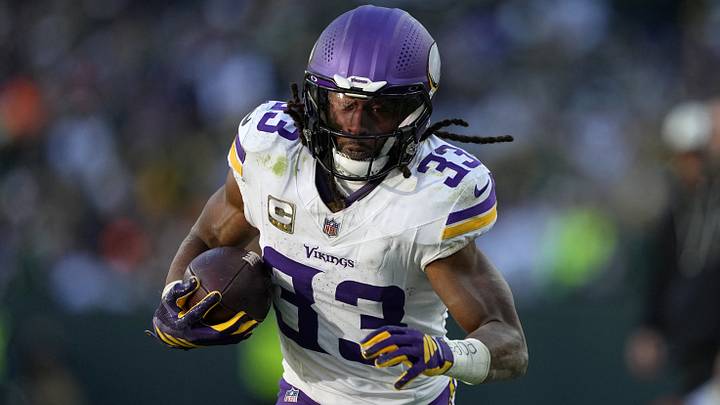
The Minnesota Vikings blew away the Green Bay Packers on Sunday afternoon, and the 30-10 victory included many of the usual suspects. Brian Flores’s defense sacked Jordan Love eight times and forced a pair of takeaways, and Will Reichard knocked down a pair of field goals.
Kirk Cousins got Justin Jefferson and the rest of the Vikings’ offense back on track, but a surprising contributor was the Vikings’ rushing attack.
The Vikings had a solid day on the ground, racking up 129 yards and averaging 4.2 yards per carry with a touchdown in the win.
While neither Jordan Mason nor Aaron Jones had a monster day, it was enough to keep the offense and the clock moving, which is another reason why Minnesota’s offense has an upward trajectory after improving to 6-2 this season.
Vikings' run game made everything click against the Packers in Week 10
The Vikings have done just about everything to fix their struggling rushing offense over the years. Since Kevin O’Connell was hired in 2022, the Vikings rank 25th with 4.1 yards per carry.
While there was improvement with 4.5 yards per carry last season, a lot of it came when the offense was altered over the final five games, and it left the Vikings looking for solutions this offseason.
Keith Carter replaced Chris Kuper as offensive line coach, and the Vikings also hired Frank Smith as an assistant head coach, hoping to learn the secrets of a Miami Dolphins offense that ranked seventh with 4.5 yards per carry dating back to 2022.
The Vikings also invested a sixth-round pick in Demond Claiborne, whose burst Jones compared to Detroit Lions star Jahmyr Gibbs during minicamp. But the changes didn’t yield results, ranking 22nd with 4.0 yards per carry and 25th with 211 attempts entering Sunday’s game against the Packers.
But things may have changed with Cousins at quarterback. With the passing game being a threat, defenses had to drop back more, which freed up space in the box for Mason and Jones.
Jones struck early with a touchdown in the second quarter and finished with 11 carries for 47 yards, and Mason finished with 59 yards on 16 carries. But it was the consistent effectiveness that helped the Vikings find a rhythm.
The evidence came when the Vikings got the ball after a Trey Smack field goal cut the lead down to 20-10 late in the third quarter.
With momentum shifting toward Green Bay, the Vikings ripped off an 11-play, 75-yard drive that took 6:50 off the clock before Cousins found Gavin Bartholomew for a 20-yard touchdown.
After Jakobe Thomas forced a fumble that Minnesota recovered on the ensuing kickoff, the Vikings once again used their ground game to their advantage, running the ball five times to kill another 4:28 off the clock and lead the team to victory.
Strong Vikings run game could make their defense even better
The Vikings’ success on the ground provided two benefits. The first was a more physical approach that allowed Minnesota to hold onto a 17-point lead they built in the first half
But it also kept third-down distances manageable and a healthy advantage in time of possession, with the Vikings having the ball for 35:16 compared to 24:44 for the Packers.
This was a big contrast over the course of the season as the Vikings ranked 17th with an average time of possession of 29:45. They also ranked 22nd in average drive time at 2:42.
If the Vikings can hang onto the ball longer, their defense has more time to recover on the sidelines. That effect showed up on Sunday as Minnesota tortured Love all afternoon and had plenty of gas left in the tank to slam the door late in the game.
If the Vikings can keep being efficient on the ground, it should help everyone moving forward and could be another reason why fans should be optimistic about this year’s team.
 Add us as a preferred source on Google