

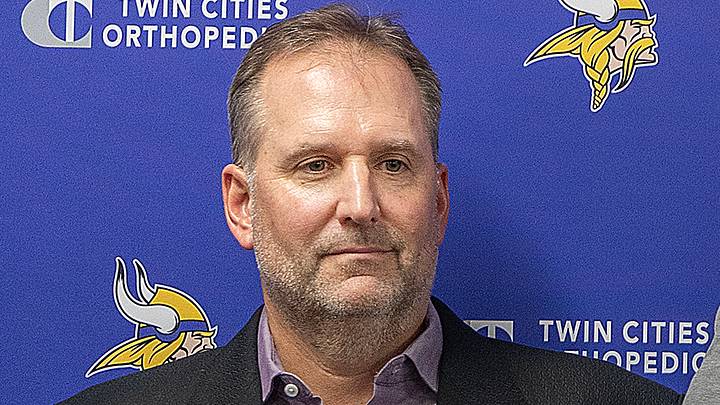
In the history of the Minnesota Vikings, Rob Brzezinski may wind up being a footnote. Joining the Vikings as the director of football administration in 1999, Brzezinski worked his way up to his current title of executive vice president of football operations in 2014 and was trusted enough to become the interim general manager in the wake of Kwesi Adofo-Mensah’s firing last January.
While Brzezinski was a legitimate candidate for the job, the Vikings ultimately tabbed Nolan Teasley as Adofo-Mensah’s replacement and sent him back to his previous role.
But just when it appeared the longtime executive’s legacy would be known as the guy who mastered financial gymnastics, he may have made one of the Vikings' most important moves in recent memory by trading Jonathan Greenard to the Philadelphia Eagles.
Greenard was a trusted leader and a player who had racked up 15 sacks and 127 pressures during his two seasons in Minnesota. But when he asked for a market revision on his new contract, Brzezinski put his foot down, traded him to the Philadelphia Eagles, and saved the Vikings from what could be one of the worst contracts in the NFL entering next season.
Rob Brzezinski's decision to trade Jonathan Greenard already looks like a win for the Minnesota Vikings
The Vikings have encountered Greenard’s situation before, and it usually led to a big contract extension that would keep that player in Minnesota.
Kyle Rudolph, Dalvin Cook, Kirk Cousins and Adam Thielen were just some of the players who were kept around on large contracts at the end of the Rick Spielman era, and Thielen and Cousins double-dipped when Adofo-Mensah took over in 2022.
Greenard was the latest example of a player who had outperformed the expectations of a four-year, $72 million contract signed in the opening hours of the 2024 free agent period. But while there were reasons to keep him around, there were also a few warning signs.
The first was Greenard’s missed tackle rate. While Greenard is one of the best players in the NFL at getting consistent pressure on the quarterback, he often looked like Wile E. Coyote finally caught the Road Runner, logging a 24.1 percent missed tackle rate over his career according to PFF.
CBS Sports’s Garrett Podell also noted that Greenard’s sack numbers fluctuated wildly due to the injury, going from a career-high 12.5 sacks during his final year with the Houston Texans in 2024 to just 3.0 sacks – albeit with an 18.1 percent pressure rate – with the Vikings last season.
In addition, Greenard also had a shoulder injury that bothered him throughout last season. While that absence gave Dallas Turner a chance to break out and eventually take his job, it also made his request for a raise odd timing and gave Brzezinski a decision to make as the interim general manager.
After trading him to the Philadelphia Eagles for a 2026 third-round pick (Jakobe Thomas) and a 2027 third-round pick, Brzezinski told the Minnesota Star Tribune’s Ben Goessling that trading Greenard “is not making the [Vikings] a better team today.”
But as Greenard signed a four-year, $98 million contract upon his arrival in Philadelphia, it’s clear that move may have made them better in the future.
Rob Brzezinski helped the Minnesota Vikings escape Jonathan Greenard’s contract nightmare
Dallas Turner’s breakout is one reason the Vikings could afford to move on from Greenard. But another is the money that they saved.
According to Over The Cap, Greenard has manageable cap hits of $6.2 million this season, $11.1 million next season, $15.7 million in 2028 and $20.2 million in 2029. But it also contains $44.4 million in dead money, which will hit the Eagles’ cap in the first of four void years beginning in 2030.
In addition, Greenard’s injury issues have gotten worse. While he has recovered from the shoulder injury that ended last season, he injured a pectoral muscle while working out this offseason.
The second ailment led Greenard to the physically unable to perform list during the opening weeks of training camp, and his availability for the start of the 2026 campaign could be in jeopardy.
While the issue has been deemed a short-term one, it also opens him up to re-injury, which could push his debut further into the regular season. This may be the smart approach, but Eagles fans aren’t exactly known for their patience, which could put a giant bullseye on Greenard’s contract if he doesn’t produce right away.
It’s a situation that Brzezinski has helped the Vikings avoid. While the trade created a need for edge rusher depth, Teasley has the flexibility to add it without Greenard’s contract on the books.
If Turner also has a career year, it will likely be cheaper to extend him than it would have been to keep Greenard last offseason.
In the Vikings' eternal pursuit of nine wins in a playoff spot, Brzezinski’s decision to trade Greenard has looked better by the day, and it could turn out to be the one move that he’s known for during his brief time as interim GM.
 Add us as a preferred source on Google